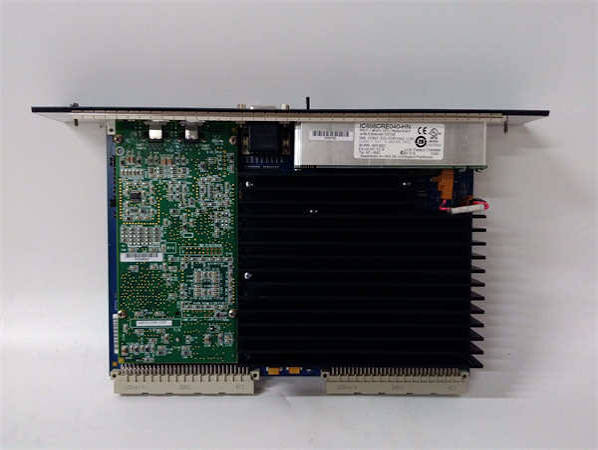
Key Features
-
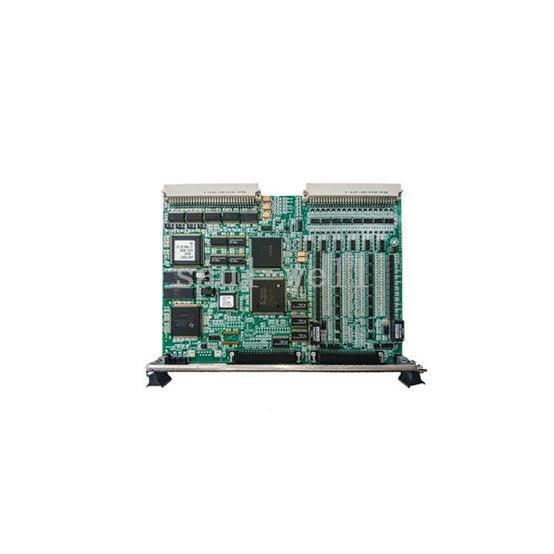
High Channel Density – A single-slot VME board integrating 48 contact inputs and 24 relay outputs, with no daughterboard design, saving valuable rack slots
-
TMR Triple Redundant Support – Signals are fanned out to the R, S, and T VME racks via JR1, JS1, and JT1 plugs, enabling triple-redundant voting logic so a single point of failure does not affect system operation
-
LED Status Diagnostics – Front panel provides RUN (green), FAIL (red), and STATUS (orange) LED indicators for quick board health diagnosis without removing the module
-
Input Filtering & Noise Immunity – Each input features a 4 ms filter to suppress noise and contact bounce, with 60 V RMS AC voltage rejection at 50/60 Hz under 125V DC excitation
-
Signal Isolation – Input channels use opto-coupler isolation; output channels use relay isolation, blocking field EMI and surge transients
-
Compact Design – Single-slot width, dimensions approximately 2.1 × 18.8 × 26.2 cm, weight approximately 0.3 kg
Technical Parameters
Core Advantages
1. Compact Single-Slot Design Saves Rack Space
As a single-slot alternative to the VCCC board, the IS200VCRCH1B delivers equivalent I/O functionality while eliminating the daughterboard structure, significantly reducing VME rack slot usage. This design advantage is particularly valuable in Mark VI systems with limited rack space.
2. TMR Redundant Architecture Ensures System Availability
In TMR configurations, the board fans out contact input voltages to the R, S, and T VME racks via JR1, JS1, and JT1 plugs. The VCMI board in each controller rack performs voting on the analysis results from the three VCCC/VCRC boards, ensuring safe system operation even if a single board fails. Relay outputs are failsafe: on cable pull or communication loss, the relays automatically de-energize.
3. Comprehensive Signal Conditioning and Protection
Each input is opto-isolated, then sampled at frame rate for control functions and at 1 ms rate for SOE (Sequence of Events) reporting. The 4 ms filter effectively suppresses common industrial electrical noise and contact bounce, ensuring accurate signal acquisition.
4. Intuitive On-Site Diagnostic Capability
Three LED indicator groups provide real-time run, fault, and status information. Combined with Mark VI diagnostic software, engineers can quickly locate wiring faults, channel anomalies, or communication problems, dramatically reducing troubleshooting time.
5. Compatibility with Multiple Relay Terminal Boards
The board works with TRLY, DRLY, SRLY and other relay terminal boards, transmitting relay control signals and monitoring feedback voltages via cables, adapting to different output configuration requirements.
Applications
The IS200VCRCH1B is widely deployed in discrete control scenarios within Mark VI systems:
Primary Functions
-
Contact Signal Acquisition – 48 dry/wet contact inputs supporting 125V DC excitation
-
Relay Output Control – 24 relay outputs driving solenoids, indicator lights, and alarm devices
-
TMR Redundant Voting – Signal fan-out to three racks for triple-redundant voting logic
-
SOE Event Recording – 1 ms sampling rate supporting sequence-of-events reporting
Recommended Models & Related Products
Important Compatibility Note: The IS200VCRCH1B relay outputs use the J3/J4 ports on the VME rack, so field cables must be routed to the front panel. If front-panel wiring is not feasible for your application, the VCCC board is recommended instead.
What's Included
Note: Terminal boards, cables, VME rack, and configuration software are sold separately.
Why Buy From Us?
-
In Stock – Ready to ship immediately
-
Fully Tested – Each board verified for functionality
-
Warranty Included – Purchase with confidence
-
Technical Support – Compatibility assistance available
Frequently Asked Questions (FAQ)
Q1: What is the GE IS200VCRCH1B?
It is a Discrete Input/Output Board for the GE Speedtronic Mark VI turbine control system, providing 48 contact inputs and 24 relay outputs for turbine safety interlocks and auxiliary equipment control.
Q2: How many inputs and outputs does this board support?
It supports 48 discrete contact inputs and 24 relay outputs.
Q3: What is the difference between the IS200VCRCH1B and the VCCC board?
Both perform the same function, but the IS200VCRCH1B is a single-slot board without a daughterboard, occupying less rack space. The VCCC is a dual-width board with a daughterboard. Because the VCRC relay outputs use the J3/J4 ports, field cables must be routed to the front panel.
Q4: Does this board support TMR redundant configurations?
Yes. Signals are fanned out to the R, S, and T VME racks via JR1, JS1, and JT1 plugs, enabling triple-redundant voting logic.
Q5: What is the input voltage for this board?
Inputs are excited by a 125 V DC (100–145 V DC) floating supply.
Q6: Is there input filtering on this board?
Yes. Each input features a 4 ms filter to suppress noise and contact bounce. AC voltage rejection at 50/60 Hz is 60 V RMS under 125V DC excitation.
Q7: Are the relay outputs failsafe?
Yes. Relay outputs are failsafe: on cable pull or loss of communication with the VME board, the input voting result de-energizes the corresponding relay.
Q8: Can this board be hot-swapped?
No. The VME rack power must be de-energized before board installation or removal. Hot-swapping can cause arcing and damage backplane connector pins.
Q9: What is the country of origin?
United States (USA).
Q10: Is this board discontinued?
Yes. The IS200VCRCH1B has been discontinued, and stock is limited. Confirm current stock availability when ordering.
Q11: What should I verify before ordering?
Always verify the exact part number (IS200VCRCH1B), confirm your system configuration (TMR or simplex), and check the existing board revision for compatibility.