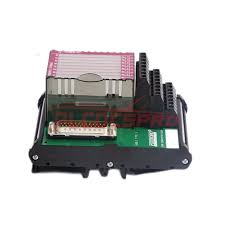
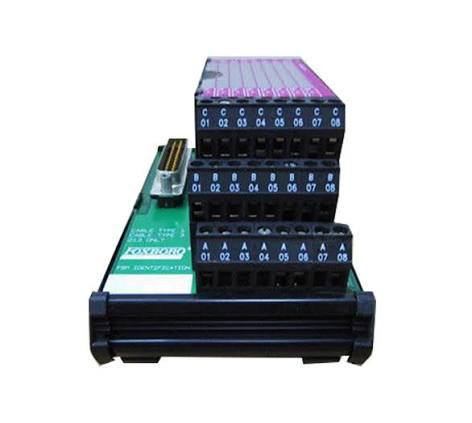
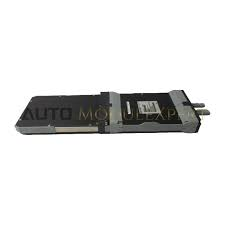
Technical Specifications
Note: Specifications may vary by hardware revision. Always verify compatibility with your specific I/A Series software version and FBM population.
Key Features & Benefits
Dual Redundant Nodebus Architecture
The CP30 features dual independent A/B Nodebus transceiver circuits, isolating a single-bus cable fault from full rack I/O operation. This architecture ensures that if one bus leg is damaged or degraded, all active control logic remains online, dramatically reducing the risk of unplanned process shutdowns .
Isolated Core and Communication Logic
The processor maintains isolated power rails and 1500 VDC galvanic isolation between the Ethernet interface and core CPU logic. This design blocks field electrical faults and surge events from propagating into sensitive processing circuitry, protecting the processor from damage caused by ground potential rises or lightning-induced transients .
High-Performance Control Execution
Powered by a 32-bit RISC core with 8 MB program Flash and 4 MB runtime RAM, the CP30 delivers fast, deterministic execution of complex control strategies. It handles continuous PID loops, sequential interlocks, and Boolean logic with the precision required for refinery, boiler, and chemical reactor control applications .
Hot-Swap Redundancy Support
In dual-redundant configurations, the CP30 supports live pull and replacement without process interruption. The standby processor seamlessly assumes control if the primary unit fails, ensuring maximum system availability and minimizing Mean Time to Repair (MTTR) .
Rugged Industrial Construction
The module is rated for ISA S71.04 G3 (harsh) environmental conditions, making it suitable for corrosive chemical plants, coastal installations, and other demanding industrial settings. It passes IEC61000-4-2/3/4/5 surge and EFT noise testing for reliable operation in electrically noisy environments .
Comprehensive Diagnostics
Front-panel LEDs for RUN, FAULT, and BUS-A/B status enable rapid visual diagnostics without requiring workstation access. Fault codes are logged to onboard non-volatile memory for detailed troubleshooting .
Recommended Related Models
Compatible I/A Series Components:
-
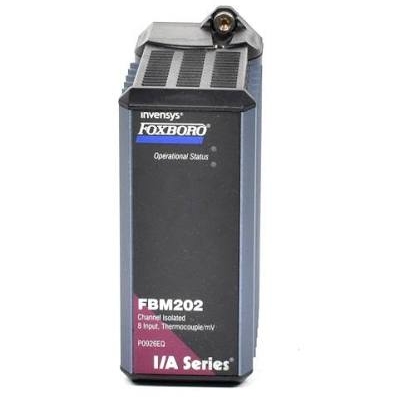
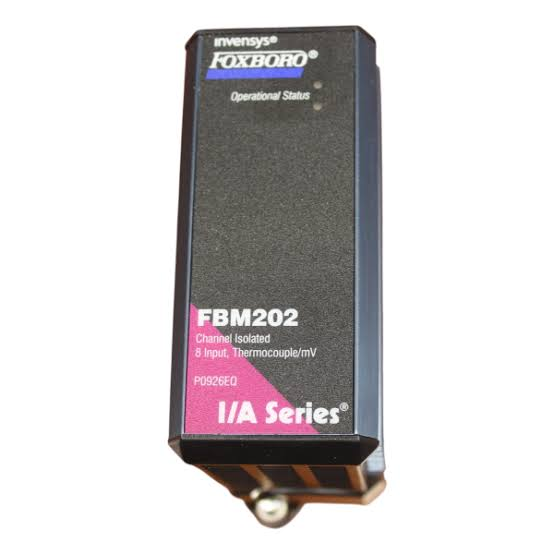
Fieldbus Modules (FBMs): FBM201, FBM202, FBM203, FBM207, FBM242, and others
-
Fieldbus Communication Modules: FCM10E (P0914YM), FCM2F2 (RH914YZ)
-
System Power Supplies: P0903CW and compatible I/A Series power modules
-
Mounting Structures: AK application racks and standard I/A Series enclosures
Frequently Asked Questions (FAQ)
Q1: What is the primary function of the Foxboro P0960AW CP30?
The CP30 is the central control processor for an I/A Series DCS rack. It executes continuous and sequential control logic, polls Fieldbus Modules (FBMs) over the Nodebus, processes field data against configured PID and interlock strategies, and communicates process values to operator workstations and historians via Ethernet .
Q2: What is the difference between the CP30 and CP30B?
The CP30B is a newer model with a faster processor, greater memory capacity, and support for additional communication protocols including Modbus TCP/IP and Ethernet/IP. The CP30B also includes built-in security features and supports the latest I/A Series software versions . The CP30 remains widely deployed in legacy installations.
Q3: Can the CP30 be replaced without shutting down the system?
Yes, but only in dual-redundant configurations. The CP30 supports hot-swap replacement in pre-configured redundant CPU racks. In non-redundant single-processor installations, the rack must be taken offline before module removal .
Q4: What type of memory does the CP30 use?
The CP30 features 8 MB of program Flash memory for storing control logic and firmware, and 4 MB of volatile runtime RAM for executing control algorithms and holding live process data .
Q5: How many FBMs can the CP30 support?
A single CP30 can directly manage up to 32 Fieldbus Modules (FBMs) on its baseplate. With the addition of an FEM100 Fieldbus Expander Module, the system can expand to support up to 128 FBMs .
Q6: What is the maximum distance for Nodebus cabling?
The Nodebus operates at a fixed 2 Mbps HDLC data rate. Standard I/A Series Nodebus cabling supports distances suitable for typical control room and cabinet installations. For extended distances, fiber optic extenders such as the FCM2F2 can be deployed.
Q7: What environmental conditions can the CP30 withstand?
The CP30 is rated for ISA S71.04 G3 (harsh) environmental conditions, suitable for corrosive industrial atmospheres. Operating temperature is -10°C to +60°C, with storage from -40°C to +85°C. It meets IEC61000-4-2/3/4/5 standards for surge and noise immunity .
Q8: What firmware considerations are important for the CP30?
Firmware version compatibility between the CP30 and installed FBM cards is critical. Mismatched firmware can cause random channel dropouts and persistent bus fault indications. Always cross-check FBM part revisions against CP firmware release notes before downloading new runtime code. In redundant configurations, both primary and standby CPUs must run identical firmware revisions .