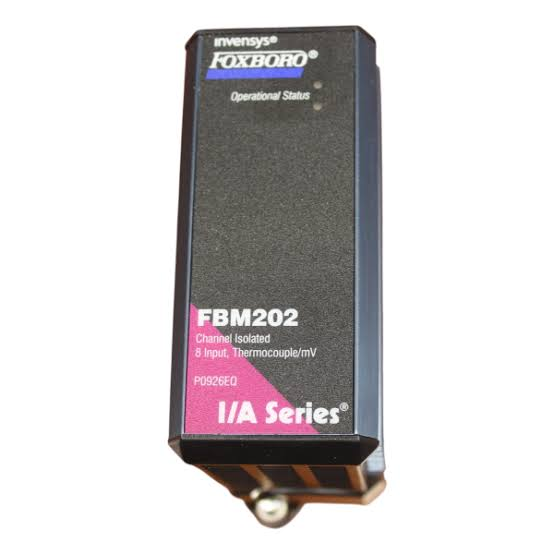
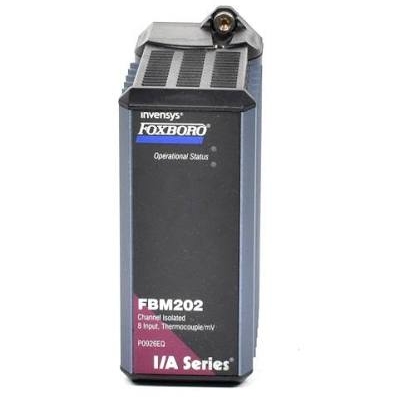
Technical Specifications
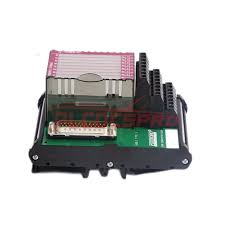
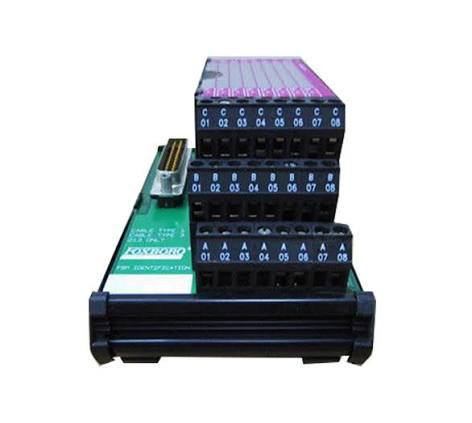
Compatible Termination Assemblies (TAs)
Note: The FBM202 requires a compatible Termination Assembly and a Type 2 termination cable (e.g., P0916DC, 3 m) for field wiring connections. The module cannot be directly connected to field sensors .
Key Features & Benefits
Eight Isolated Thermocouple Channels with Burnout Detection
The FBM202 provides 8 fully isolated, independent thermocouple/mV input channels, each accepting standard thermocouples (B, E, J, K, N, R, S, T) or general millivolt signals. Each channel provides thermocouple burnout detection (upscale) for immediate notification of sensor failures or broken wiring. The per-channel galvanic isolation withstands 600 V AC, preventing ground loops, field faults, and cross-channel interference from propagating through the system .
Integrated Cold-Junction Compensation
The module includes one isolated RTD reference junction compensation channel for terminal temperature sensing. A 4-wire 100 Ω Platinum RTD (IEC 751, Class B) is integrated into the termination assembly, automatically compensating for ambient temperature fluctuations at the terminal block. This eliminates the need for external compensation hardware, reduces wiring complexity, and ensures precise temperature measurement across varying environmental conditions .
High-Precision Sigma-Delta Conversion
Each channel incorporates an independent Sigma-Delta analog-to-digital converter providing 15/16-bit resolution and ±0.03% of span accuracy (±24-27 µV) for millivolt inputs. The module provides new analog input readings every 25 ms with a configurable integration period to remove process noise and 50/60 Hz power line frequency interference. This architecture delivers exceptional measurement stability for critical temperature monitoring applications .
Redundant Fieldbus Architecture
As a main-type FBM, the module independently connects to the redundant 2 Mbps Fieldbus. If one Fieldbus path fails, the module automatically switches to the alternate path, maintaining continuous data exchange with the control processor without process interruption .
Hot-Swap Capability
The FBM202 supports live insert and removal on an energized I/A Series baseplate. The module can be removed or replaced without disconnecting field wiring, power, or communication cabling. Combined with true plug-and-play hot-swap capability, routine hardware replacements happen transparently while the process continues running .
Rugged Industrial Construction
The module features a rugged extruded aluminum housing for physical protection of circuits. It is rated for Class G3 (Harsh) environmental contamination per ISA S71.04, suitable for corrosive chemical plants, coastal installations, and other demanding industrial settings .
Software-Configurable Options
The Analog Input application program provides configurable options including integration time and Rate of Change Limits. Each channel can be independently configured via software for different thermocouple types or millivolt ranges .
Recommended Related Models
Compatible I/A Series Components:
-
Control Processors: CP60, FCP270, FCP280
-
Termination Cable: P0916DC (Type 2, 3 m)
-
Termination Assemblies: P0916AC, P0916AD, P0916XH, P0917JL
-
Fieldbus Communication Modules: FCM10E, FCM2F2
Frequently Asked Questions (FAQ)
Q1: What is the primary function of the Foxboro FBM202 (P0926EQ)?
The FBM202 is an 8-channel thermocouple/mV input module for the I/A Series and Foxboro Evo DCS. It accepts low-level thermocouple or millivolt signals from field temperature sensors, performs signal conversion and cold-junction compensation, and transmits digitized temperature data to the control processor over the redundant Fieldbus .
Q2: What thermocouple types does the FBM202 support?
The module supports B, E, J, K, N, R, S, and T type thermocouples, as well as general millivolt signals within the -10.5 to +69.5 mV DC range .
Q3: What is the input range and accuracy of the FBM202?
The input range is -10.5 to +69.5 mV DC. Accuracy specifications are:
-
Millivolt input: ±0.03% of span (±24-27 µV) at 25°C
-
Thermocouple conformity: ±0.25°C
-
RTD reference junction: ±0.50°C (with Foxboro TAs)
Q4: Does the FBM202 require an external cold-junction compensation sensor?
No. The module uses a 4-wire 100 Ω Platinum RTD integrated into the compatible termination assembly for automatic cold-junction compensation. This eliminates the need for external reference blocks or ice-bath calibration .
Q5: Can the FBM202 be replaced without shutting down the system?
Yes. The FBM202 supports hot-swap replacement on an energized I/A Series baseplate. Field wiring, power, and communication cables remain undisturbed, and the redundant Fieldbus ensures no loss of communication during the swap .
Q6: What environmental conditions can the FBM202 withstand?
The module is rated for Class G3 (Harsh) environmental contamination per ISA S71.04. Operating temperature is -20°C to +70°C, with storage from -40°C to +85°C .
Q7: What is the difference between P0926EQ and RH926EQ?
RH926EQ is the later replacement part number for the P0926EQ. Both are hardware compatible and directly interchangeable .
Q8: Can the FBM202 be used with other signal types (4-20 mA, RTD)?
No. The FBM202 is specifically designed for thermocouple and millivolt inputs only. For RTD inputs, use FBM203; for 4-20 mA analog inputs, use FBM201. Mixing signal types can damage the module .
Q9: What is the integration time and update rate of the FBM202?
The module provides new analog input readings every 25 ms with a software-configurable integration period to suppress noise and power line frequency interference .
Q10: What are typical applications for the FBM202?
The module is commonly used for: boiler furnace temperature control in power generation, chemical reactor monitoring in petrochemical plants, furnace zone temperature feedback in metallurgical processes, and precise temperature measurement in pharmaceutical manufacturing .
Q11: Does this module come with a warranty?
Yes. This offering includes a 1 Year (12-month) Warranty on the module. Verify warranty terms with your supplier before purchase .