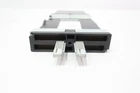
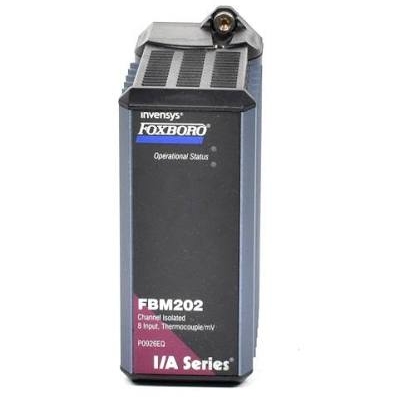
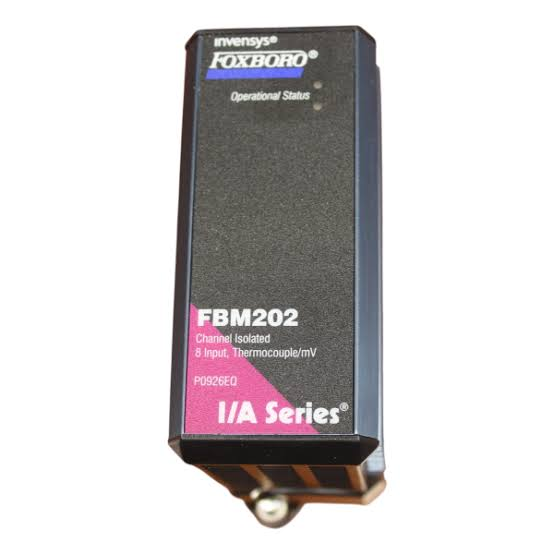
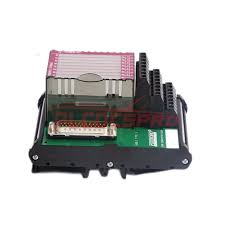
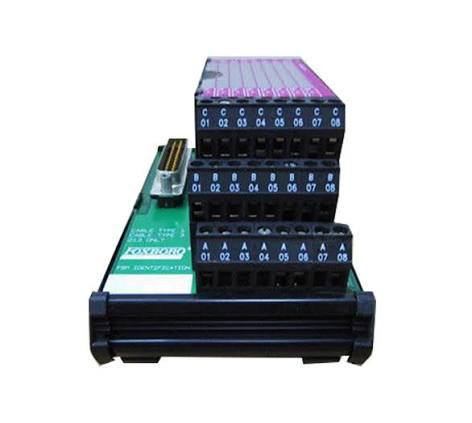
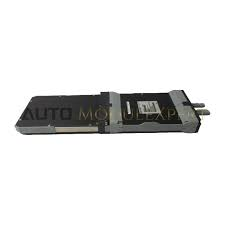
Technical Specifications
Terminal Connection Options
Key Features & Benefits
Dual-Mode Input Capability (Contact Sense or DC Voltage Monitor)
The FBM07 supports two distinct input modes: dry contact sensing (detecting switch/relay closures) and DC voltage monitoring (detecting on/off voltage states from field devices). This dual functionality allows a single module type to serve diverse digital input applications across the plant, simplifying spare parts inventory and reducing engineering complexity.
Expandable to 32 Channels via FBM12
The FBM07 is an expandable main module that supports one FBM12 Expansion Input Interface Module, doubling capacity from 16 to 32 digital inputs while using only a single Fieldbus connection. This expansion capability reduces cabinet space requirements, minimizes Fieldbus node consumption, and simplifies system growth.
Channel-Pair Isolation with High Voltage Withstand
Inputs are isolated in pairs (channels 1 & 2 share a common return, isolated from channels 3 & 4, etc.). The module withstands 1250 V AC for one minute between channel pairs and between any channel and earth. When hazardous voltages (greater than 60 V DC) are used, both channels of a pair must be used with hazardous voltages—hazardous and non-hazardous voltages must not be mixed within a pair.
Configurable Input Filter Time
The module supports software-configurable input filter times of 4, 8, 16, or 32 ms, allowing engineers to optimize the balance between noise immunity and response speed for each application. Longer filter times reject contact bounce and electrical noise; shorter times capture fast transitions for pulse counting and sequence-of-events monitoring.
Multiple Application Program Support
When used alone or with an input-only expansion module, the FBM07 executes one of the following application programs: Digital I/O, Sequence of Events Monitor, Pulse Count Inputs, or Ladder Logic. The configurable option for each is Input Filter Time.
Hot-Swap Capability
The FBM07 supports live insert and removal on an energized I/A Series baseplate. Field wiring, power, and communication cables remain undisturbed, and the redundant Fieldbus ensures no loss of communication during the swap, enabling maintenance during continuous process operations.
Rugged Industrial Construction
Rated for Class G3 (Harsh) environmental conditions per ISA S71.04, the module is suitable for corrosive chemical plants, refineries, and other demanding industrial settings. It operates reliably across a temperature range of 0°C to +60°C with 5% to 95% non-condensing humidity.
Recommended Related Models
Compatible I/A Series Components:
-
Control Processors: CP30, CP40, CP60, FCP270
-
Fieldbus Communication Modules: FCM10E, FCM2F2
-
Expansion Module: FBM12 (CM400YN)
-
Termination Assemblies (TAs): For locally or remotely connecting field wiring
Frequently Asked Questions (FAQ)
Q1: What is the primary function of the Foxboro P0400YH FBM07?
The FBM07 is a 16-channel Contact/DC Input Interface Module for the I/A Series DCS. It converts digital contact closures or DC voltage signals from field devices into data for the control processor via the redundant Fieldbus. It supports Digital I/O, Sequence of Events, Pulse Count, and Ladder Logic applications.
Q2: What input signals does the FBM07 support?
Depending on the hardware version, the FBM07 supports: dry contact sensing, 15–130 VDC voltage monitoring, pulse count inputs, and Sequence of Events (SOE) monitoring.
Q3: Can the FBM07 be expanded beyond 16 channels?
Yes. One FBM12 Expansion Module can be connected to the FBM07, increasing capacity from 16 to 32 digital inputs without requiring another primary Fieldbus connection.
Q4: What is the isolation rating of the FBM07?
Inputs are isolated in pairs. The module withstands 1250 V AC for one minute between channel pairs and between any channel and earth. When hazardous voltages (>60 V DC) are used, both channels of a pair must use hazardous voltages—mixing hazardous and non-hazardous voltages within a pair is prohibited.
Q5: What filter time options are available?
The input filter time is software-configurable with four options: 4 ms, 8 ms, 16 ms, or 32 ms.
Q6: Can the FBM07 be replaced without shutting down the system?
Yes. The FBM07 supports hot-swap replacement on an energized I/A Series baseplate. Field wiring, power, and communication cables remain undisturbed, and the redundant Fieldbus ensures no loss of communication during the swap.
Q7: What environmental conditions can the FBM07 withstand?
The module is rated for Class G3 (Harsh) environmental contamination per ISA S71.04. Operating temperature is 0°C to +60°C, with storage from -40°C to +85°C. Humidity range is 5% to 95% non-condensing.
Q8: What are the configurable options for the FBM07?
The configurable options depend on the application program selected:
-
Digital I/O, SOE, Pulse Count, or Ladder Logic (alone or with input-only expansion): Input Filter Time (per module basis)
-
Digital I/O or Ladder Logic (with input/output expansion): Input Filter Time, Fail Safe Configuration, Fail Safe Fallback, Sustained or Momentary Outputs, Pulse Output Interval
Q9: What is the difference between the FBM07 and FBM12?
The FBM07 (P0400YH) is the expandable main module that independently connects to the Fieldbus. The FBM12 (CM400YN) is the expansion module that connects to the Fieldbus via an FBM07 and is functionally dependent on the supporting main module. The FBM12 cannot operate without an FBM07.
Q10: Is the FBM07 still available?
The FBM07 is a legacy 100 Series module. While no longer a current-generation product, replacement units remain available through aftermarket suppliers as new surplus, unused inventory, or professionally tested refurbished modules. For Foxboro Evo migration projects, the FBM217 (voltage monitor) or FBM219 (contact sensor) are commonly used successor platforms.