Key Parameters and Features
Core Features & Advantages
-
Full Channel-to-Channel Isolation: The module’s standout feature is its complete galvanic isolation between all 16 input channels and the system backplane. This architecture eliminates ground loop interference and prevents fault propagation between field devices, ensuring signal integrity even in electrically noisy plant environments .
-
HART Digital Communication Pass-Through: The -H50 designation includes integrated HART protocol support, enabling remote configuration, diagnostic reading, and secondary variable acquisition from smart transmitters directly through the DCS maintenance station. This eliminates the need for handheld communicators or external multiplexers .
-
High-Density with Flexible Transmitter Support: The 16-channel design saves valuable cabinet space, while each channel is independently configurable for 2-wire or 4-wire transmitters. The module provides built-in power supply for 2-wire devices, simplifying field wiring .
-
Hot-Swap Capability for High Availability: The module supports online replacement without system shutdown, minimizing downtime during maintenance. It can also be paired in dual-redundant configurations, ensuring uninterrupted data acquisition during hardware failures .
Typical Applications
The AAI143-H50 S1 is widely used for critical process control applications across heavy industries :
-
Oil & Gas: Refinery process control, pipeline monitoring, and offshore platform instrumentation
-
Petrochemical: Reactor temperature, pressure, and flow monitoring
-
Power Generation: Boiler and turbine parameter acquisition
-
Chemical Processing: pH, conductivity, and level transmitter integration
Frequently Asked Questions (FAQ)
Q1: What is the primary function of the AAI143-H50 S1?
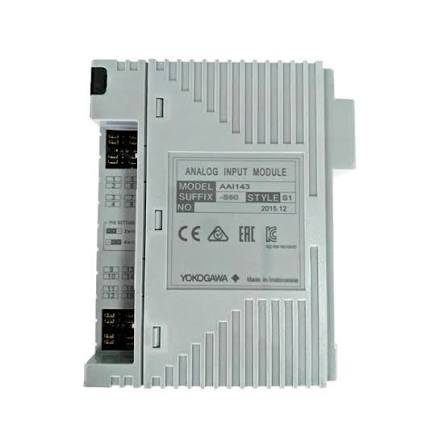
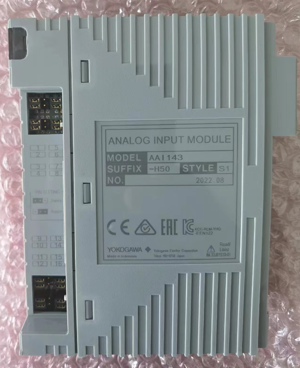
A: It is a 16-channel isolated analog input module for CENTUM VP/CS 3000 DCS. Its role is to acquire 4-20 mA signals from field transmitters, convert them to digital data, and support HART communication for smart device management .
Q2: What does the "-H50" designation indicate?
A: The -H50 suffix signifies that the module includes HART digital communication capability. The -H00 variant lacks HART support .
Q3: What does the "S1" designation mean?
A: The S1 indicates a factory-bundled set where the module and ATK4A-00 KS Cable Interface Adapter are pre-assembled and tested for high-density AEA4D terminal board connectivity .
Q4: Can both 2-wire and 4-wire transmitters be connected?
A: Yes. Each channel can be independently configured for 2-wire or 4-wire transmitters using pin settings. The module provides built-in power supply for 2-wire devices .
Q5: What is the accuracy and resolution?
A: Accuracy is ±16 µA (approximately ±0.1% of full scale) with 16-bit A/D resolution .
Q6: Does the module support redundancy?
A: Yes. It can be paired in a dual-redundant configuration, ensuring uninterrupted data acquisition during hardware failures .
Q7: Is the module suitable for intrinsically safe applications?
A: Not directly. The module itself is non-intrinsically-safe. For hazardous area installations, external isolation barriers are required. Zener barriers are not allowed .
Q8: What are the physical dimensions and weight?
A: The module measures 107.5 × 32.8 × 130 mm and weighs 0.3 kg .
Recommended Models & Related Products
The AAI143-H50 S1 is part of Yokogawa's FIO analog input module family. Below are related models and components:
Choosing the Right Model
-
For HART smart device integration: The AAI143-H50 S1 is the correct choice, providing HART pass-through for remote configuration and diagnostics .
-
For standard analog input without HART: The AAI143-H00 S1 offers the same core functionality at lower cost .
-
For analog output requirements: Consider the AAI543-H50 for 16-channel 4-20 mA output with HART support .