Product Details
Related Product Model Recommendations
Payment & Delivery

FAQs

Q1: What is the primary function of the 6ES7516-3FP03-0AB0?
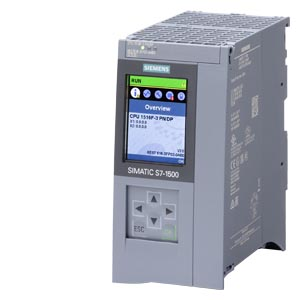
It is a fail-safe CPU in the SIMATIC S7-1500F family, designed for both standard control and safety-related control (emergency stop, safety door monitoring, etc.) in a single device. It is certified up to SIL 3 / PL e, making it suitable for demanding safety applications in manufacturing and process industries.
Q2: What TIA Portal version is required to program this CPU?
The CPU 1516F-3 PN/DP requires STEP 7 TIA Portal V18 (for firmware V3.0) or higher. For older TIA Portal versions (V16/V17), the CPU can be configured as 6ES7516-3FN02-0AB0, but users have reported loading errors when attempting this approach. It is recommended to use TIA Portal V18 or higher for full compatibility.
Q3: Does this CPU require a SIMATIC Memory Card?
Yes. The CPU 1516F-3 PN/DP requires a SIMATIC Memory Card for operation. The card serves as the load memory and is essential for program storage and data management. Maximum supported capacity is 32 GB.
Q4: What are the key communication interfaces?
The CPU provides three PROFINET interfaces: X1 with a 2-port switch supporting IRT and RT, X2 for general communication (HMI, programming), and X3 for PROFIBUS DP Master (up to 125 slaves). The CPU supports PROFIsafe V2.4/V2.6 for safety communication, OPC UA Server (runtime license required), MRP (200 ms switchover time), and S7 routing.
Q5: What are the common causes of "No valid F address available" errors?
Common causes include:
-
Missing F-coding element: For S7-1500 fail-safe modules, the F-coding element must be plugged between the module and front connector to store F-parameters. If missing, parameters cannot be assigned.
-
Protection level configuration: If the project uses a predecessor CPU type (e.g., 3FN02) while the actual hardware is 3FP03, and protection levels are configured, the F-address assignment may fail. Change to "full access including failsafe" temporarily, compile, download, then re-add protection levels.
-
Firmware/configuration mismatch: Ensure the TIA Portal project matches the actual CPU firmware version.