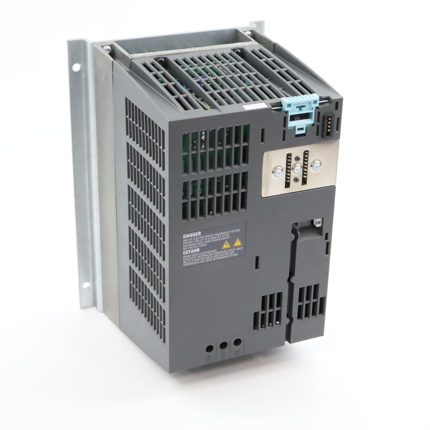
Product Details
Related Product Model Recommendations
Payment & Delivery
FAQs

Q1: What is the difference between the 6ES7214-1AG40-0XB0 and the 6ES7214-1HG40-0XB0?
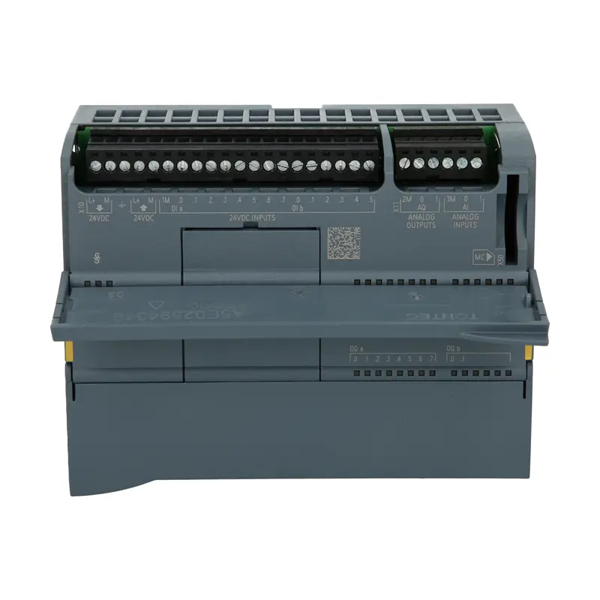
The primary difference is the digital output type. The 6ES7214-1AG40-0XB0 (this model) features transistor outputs (DC/DC/DC), suitable for high-frequency switching and DC loads only. The 6ES7214-1HG40-0XB0 features relay outputs (DC/DC/Relay), capable of switching AC or DC loads directly (up to 2A per output) but with slower switching speed . Transistor outputs offer faster switching and longer life; relay outputs are preferred for mixed AC/DC loads or higher current applications.
Q2: What firmware version is required for OPC UA server functionality?
The integrated OPC UA server requires firmware V4.4 or higher . The latest firmware available is V4.7, which requires TIA Portal V18 or higher for configuration . When using older TIA Portal versions, the project can be configured with a lower firmware version and downloaded to a CPU with newer firmware (the CPU will run in compatibility mode, though new features of the higher firmware will not be accessible) .
Q3: What software is required to program this CPU?
The CPU requires STEP 7 Basic or Professional V13 or higher (TIA Portal) . For firmware V4.7, TIA Portal V18 or higher is required . It is programmed using the TIA Portal environment, which provides integrated hardware configuration, programming, and diagnostics.
Q4: What are the motion control capabilities of this CPU?
The CPU supports 6 high-speed counters (max. 100 kHz single-phase / 80 kHz differential) and 4 pulse outputs (100 kHz) . These can be configured for PLCopen motion control to control stepper motors or servo drives via pulse-direction interface. Up to 8 positioning axes can be configured, making it suitable for simple positioning tasks. For more complex motion control, the S7-1500 platform is recommended.
Q5: Can the 6ES7214-1AG40-0XB0 be expanded with additional I/O modules?
Yes. The CPU 1214C supports expansion with up to 8 Signal Modules (SM), 1 Signal Board (SB), and 3 Communication Modules (CM) . The integrated I/O can be expanded from 14DI/10DO to a maximum of 1024 I/O points via the expansion modules.