Product Details
Related Product Model Recommendations
Payment & Delivery

FAQs

Q1: What is the primary function of the 3500/53-03-00?
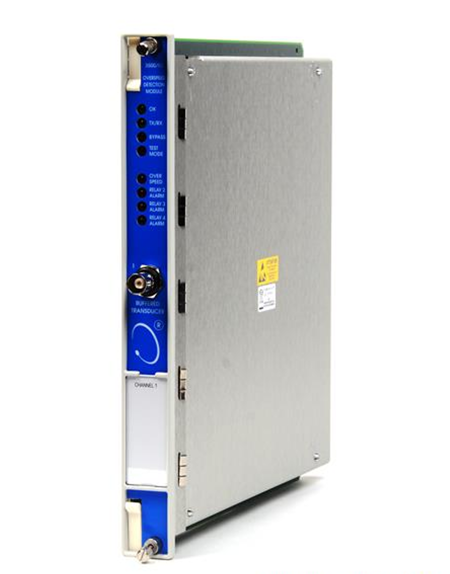
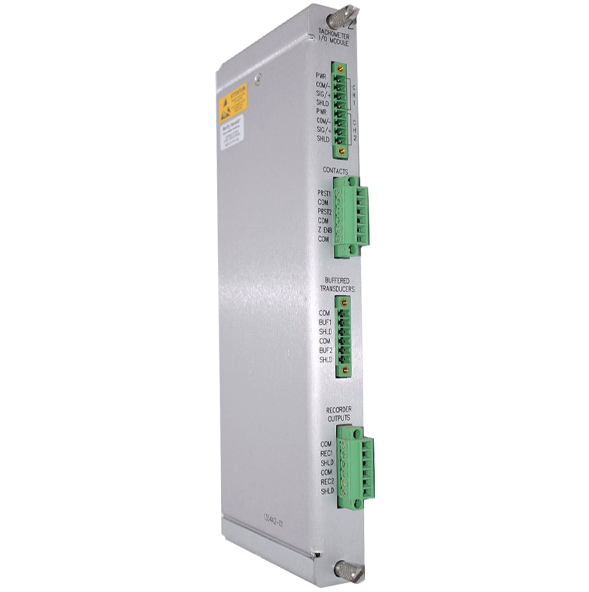
It is a dedicated Electronic Overspeed Detection Module that provides high-reliability, fast-response overspeed protection for critical rotating machinery. It continuously monitors shaft speed via proximity probes or magnetic pickups and triggers alarm or shutdown relays when speed exceeds user-programmable setpoints . It is not a general-purpose speed monitor — it is specifically designed as part of an overspeed protection system meeting API 670 and 612 standards .
Q2: What is the difference between 2oo2 and 2oo3 voting?
The 3500/53 modules can be combined to form 2-out-of-2 (2oo2) or 2-out-of-3 (2oo3) voting systems . In 2oo2, two modules must both detect overspeed to trigger a trip. In 2oo3 (recommended by Bently Nevada), three modules vote, and any two detecting overspeed will trigger a trip. The 2oo3 configuration provides higher availability — a single module failure will not cause a false trip or prevent a valid trip .
Q3: What sensors are compatible with the 3500/53?
The module supports a wide range of Bently Nevada sensors including 3300 8mm Proximitor, 3300 16mm HTPS (high-temperature), 7200 5mm/8mm/11mm/14mm Proximitor, 3300 RAM Proximitor, and magnetic pickups . The input signal range is +10.0 V to -24.0 V, with signals outside this range limited internally by the module .
Q4: Does the 3500/53 require redundant power supplies?
Yes. The use of redundant power supplies (two 3500/15 modules) in the rack containing the Overspeed Detection System is mandatory . This ensures that a single power supply failure cannot disable the overspeed protection function.
Q5: What is the difference between the 3500/53 and the 3500/53M?
The 3500/53M is the M-series upgrade featuring a split-base design (separate front card and removable rear I/O base 133396-01). This allows field wiring and barrier modifications without removing the main measurement card from the rack, reducing maintenance downtime . The 3500/53M also offers faster overspeed trip response (<10 ms) compared to the legacy integrated-terminal 3500/53 hardware . The 3500/53M is recommended for new projects, while the legacy 3500/53 remains available for existing system maintenance.