Key Parameters and Features
Core Features & Advantages
-
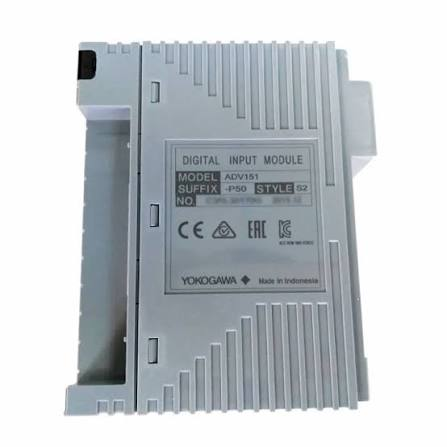
High-Density 32-Channel Design: The module's standout feature is its ability to consolidate 32 digital output channels into a single slot, significantly saving cabinet space in large-scale DCS installations. This high-density architecture is ideal for applications with numerous discrete control points, such as valve banks, motor starters, and alarm annunciators .
-
Per-Channel Galvanic Isolation: The ADV151 provides complete galvanic isolation between each output channel and the system backplane, eliminating ground loop interference and preventing fault propagation between field devices. This ensures signal integrity even in electrically noisy plant environments .
-
Dual-Redundant Configuration Support: The module supports dual-redundant configurations, providing higher reliability and fault tolerance for mission-critical process automation networks. When one module fails, the redundant partner continues operation without interruption .
-
Built-in Diagnostic Capabilities: The module includes short-circuit and overload protection, channel fault self-diagnosis, and status feedback functions. Front-panel LEDs provide visual indication of channel operation and system status, enabling rapid troubleshooting .
-
Hot-Swap Capability: The module supports online replacement without system shutdown, minimizing downtime during maintenance. It can be replaced while the system is running, ensuring continuous process control .
-
Flexible Connection Options: The module can be connected to field devices by terminal connection, terminal block via a KS cable interface adapter, or with a customer-furnished MIL cable. A pressure clamp terminal block is also available for direct field wiring .
Typical Applications
The ADV151 is widely used for discrete output control in process industries:
-
Oil & Gas: Refinery valve control, pipeline actuator management, and emergency shutdown systems
-
Chemical & Petrochemical: Reactor feed control, pump start/stop, and alarm annunciation
-
Power Generation: Boiler auxiliary control, turbine trip circuits, and balance-of-plant equipment
-
Pharmaceutical: Batch process control and cleanroom equipment management
-
Water & Wastewater: Pump station control and valve actuation
Frequently Asked Questions (FAQ)
Q1: What is the primary function of the ADV151?
A: It is a 32-channel digital output module for Yokogawa CENTUM VP/CS 3000 DCS. Its role is to receive control signals from the DCS controller and output isolated transistor contact signals to drive field devices such as solenoids, relays, and indicator lights .
Q2: What does the "-P" and "-E" suffix indicate?
A: The -P suffix indicates the module is configured for pushbutton input (with SOE capture capability for sequence of events recording). The -E suffix indicates SOE capture functionality. The -5 and -6 suffixes indicate without status display and with status display respectively .
Q3: Is the ADV151 an input or output module?
A: It is a Digital Output Module. For digital input functionality, refer to the ADV141, ADV142, or ADV161 series .
Q4: Can the ADV151 be used in a redundant configuration?
A: Yes. It supports dual-redundant configurations with dedicated terminal blocks (such as AEA4D or AET4D). Both modules must be identical models for proper redundancy operation .
Q5: What is the external power supply requirement?
A: The external power supply voltage range for the ADV151 is 18–26.4 V DC (nominal 24 V DC) .
Q6: Does the module support hot-swapping?
A: Yes. The module supports online replacement without system shutdown, provided proper system grounding and redundancy configuration are maintained .
Q7: What terminal boards are compatible with the ADV151?
A: Compatible terminal boards include ATA4S (pressure clamp), AEA4D (dual-redundant), and connections via KS cable interface adapter (such as ATK4A-00). The module can also be connected directly using customer-furnished MIL cables .
Q8: What are the key LED indicators on the module?
A: The module features front-panel status indicator lights for channel operation and system status, enabling quick visual verification of output states and module health .
Recommended Models & Related Products
The ADV151 is part of Yokogawa's FIO digital output module family. Below are related models and components:
Choosing the Right Model
-
For standard 32-channel digital output applications: The ADV151 is the correct choice for CENTUM VP/CS 3000 systems requiring high-density discrete output control .
-
For higher channel density: The ADV561 provides 64 output channels in a single module .
-
For relay output requirements: The ADV541 offers 16 channels of relay contact output for switching higher voltage/current loads .
-
For redundant configurations: Pair two ADV151 modules with the AEA4D terminal board for dual-redundant operation .