Key Features
Technical Specifications
General
Analog Inputs
Outputs
Digital Inputs
Setpoint Programming
Control & Tuning
Communication
Electrical
Environmental & Certifications
Part Number Decoding
The UDC2800-E0-1L0-200-000-00 configuration indicates:
Note: For exact configuration details, refer to Honeywell's UDC2800 ordering guide or contact your authorized distributor.
Applications
The UDC2800 is suitable for precise process control across multiple industries:
-
Heat Treating: Furnaces, ovens, and heat treatment processes requiring ASM2750F compliance
-
Food & Beverage: Cookers, dryers, and freezers with washdown requirements (NEMA 4X/IP66)
-
Environmental Chambers: Precise temperature and humidity control
-
Boilers & Heaters: Single-loop control for industrial heating systems
-
Aerospace: Heat treatment applications meeting aerospace standards
-
General Industrial: Steel, paper, wastewater, and chemical processing plants
Key Benefits
Important Notes
-
Backward Compatibility: The UDC2800 retains the same 1/4 DIN form factor, terminal arrangement, and back panel as UDC2500 and UDC3200 controllers.
-
Case Reuse: UDC2800 can be installed into existing UDC2500/UDC3200 cases, reducing changeover downtime.
-
EasySet App: Configuration via Bluetooth requires Honeywell EasySet mobile app (free download for iOS 12.0+ or Android 9+).
-
Firmware Updates: Firmware can be upgraded via the EasySet app.
-
Legacy Configuration Import: Legacy UDC2500/UDC3200 configurations can be imported to UDC2800 via EasySet app.
-
Dual Loop Functionality: Available in firmware Release 200.0 and later.
-
Warranty: Standard 18-month warranty.
FAQ
Q1: What is the primary function of the Honeywell UDC2800-E0-1L0-200-000-00?
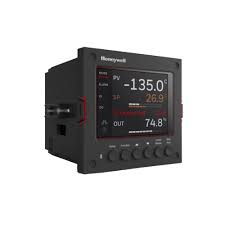
A: It is a 1/4 DIN Universal Digital Controller designed for precise temperature and process control. This specific configuration is a Limit Controller with electromechanical relay output, universal 90-264 VAC power supply, and no communication option installed.
Q2: What does the UDC2800 replace?
A: The UDC2800 is a direct replacement for the retired Honeywell UDC2500 and UDC3200 controllers. It maintains full backward compatibility with the same 1/4 DIN form factor, terminal arrangement, and back panel.
Q3: What are the input types supported?
A: The UDC2800 features two universal analog inputs supporting Thermocouple (TC), RTD, mV, mA, V, RH, carbon, and oxygen inputs as standard.
Q4: What is the accuracy of the controller?
A: The typical accuracy is ±0.15% of full-scale input, and it can be field calibrated to ±0.05% of full scale.
Q5: How fast is the scanning rate?
A: The UDC2800 samples both analog inputs at 10 samples per second (every 100 ms), enabling fast trend detection.
Q6: What communication options are available?
A: Communication options include RS485 Modbus RTU, Ethernet TCP/IP (10/100M Base-T), and Bluetooth BLE 4.2. This specific configuration (000) does not include communication options installed.
Q7: What is the power supply requirement?
A: The controller operates on universal 90 to 264 VAC, 50/60 Hz power without jumper changes. An optional 24 VAC/DC power supply is also available.
Q8: What is the front face protection rating?
A: The front face is rated NEMA 4X and IP66, making it suitable for washdown applications in food and beverage processing.
Q9: What is the maximum setpoint programming capability?
A: The UDC2800 supports 8 setpoint programs, each with 4 ramp and 4 soak segments, with the ability to link up to 64 segments total.
Q10: How does Bluetooth configuration work?
A: The UDC2800 features Bluetooth BLE 4.2 connectivity. Using Honeywell's free EasySet mobile app (iOS 12.0+ or Android 9+), you can configure the controller, download/upload complete device configurations, and duplicate settings across multiple controllers, saving up to 80% of configuration time.
Q11: Is the UDC2800 ASM2750F compliant?
A: Yes, the UDC2800 is ASM2750F aerospace standard compliant, making it suitable for aerospace heat treatment applications.
Q12: What tuning algorithms are available?
A: The controller features Accutune III with Fast Tune, Slow Tune, and Duplex Tune (heat/cool) options, plus Fuzzy Logic overshoot suppression as a standard feature.