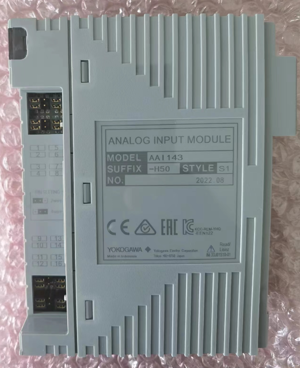
Key Features
-
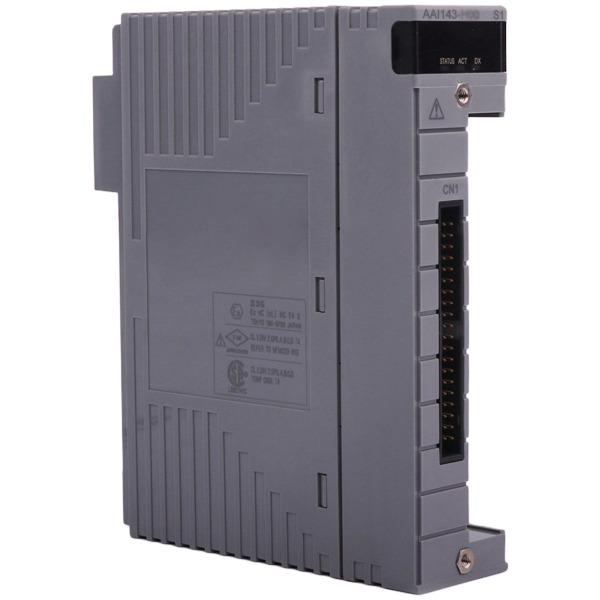
16 Isolated Input Channels – Each channel provides full galvanic isolation, preventing ground loop interference and protecting the DCS backplane from field-side surge faults
-
HART Digital Communication – Pass-through capability for smart transmitter diagnostics, remote calibration, and asset management via Yokogawa PRM software
-
2-Wire / 4-Wire Transmitter Support – Independently configurable per channel, accommodating a wide range of field instruments
-
1500 V AC Isolation – Input-to-system isolation withstand voltage for 1 minute, ensuring signal integrity in electrically noisy environments
-
High-Precision A/D Conversion – 16-bit resolution with ±0.1% full-scale accuracy for reliable process measurement
-
Fast Data Update – 10 ms per channel update period for responsive process monitoring
-
Built-in Transmitter Power Supply – ≥19.0 V DC at 20 mA for 2-wire transmitters, eliminating the need for external power supplies
-
Dual Redundant Configuration Support – Compatible with hot-swap installation in redundant DCS racks for high-availability applications
-
Comprehensive Self-Diagnostics – Front-panel LED indicators for module status, channel faults, and HART communication errors; automatic detection of wire breaks, over-range signals, and hardware faults
Technical Parameters
Core Advantages
1. Full Channel Isolation for Maximum System Stability
The AAI143-H50 S1 employs a full channel isolation design, meaning a short circuit or surge fault on a single channel will not propagate to crash the entire DCS rack. This architecture is critical in process plants where field wiring is exposed to harsh electrical environments. The 1500 V AC isolation withstand voltage provides an effective barrier against ground loops, noise, and transient surges.
2. Native HART Communication for Smart Instrument Management
The -H50 designation activates native HART pass-through capability, enabling the DCS to communicate bidirectionally with smart field transmitters. This allows engineers to remotely calibrate instruments, read diagnostic data, and monitor device health via Yokogawa PRM (Plant Resource Manager) software—all without sending personnel to the field. This capability significantly reduces maintenance costs and improves plant reliability.
3. High-Density Design for Cabinet Space Savings
With 16 channels in a single module, the AAI143-H50 S1 maximizes I/O density, reducing the total number of racks required and saving valuable cabinet space. This is particularly valuable in large-scale process plants where thousands of analog points must be monitored.
4. Dual Redundant and Hot-Swap Capable
The module supports dual redundant rack configurations, ensuring uninterrupted process monitoring even during hardware failure. Hot-swap capability allows online replacement without stopping the production process—a critical advantage in continuous process industries such as refining, petrochemicals, and power generation.
5. Comprehensive Self-Diagnostics
Built-in BIST (Built-In Self-Test) functions automatically detect broken wiring, transmitter power loss, and abnormal loop signals. Front-panel LEDs provide immediate visual indication of module power, channel faults, and HART communication errors, enabling fast troubleshooting and minimizing downtime.
Applications
The YOKOGAWA AAI143-H50 S1 is deployed across continuous process industries where reliable analog signal acquisition is essential:
Primary Functions
-
Analog Signal Acquisition – Receives 4–20 mA signals from pressure, flow, temperature, and level transmitters
-
High-Precision A/D Conversion – Converts analog process signals into digital data for DCS controller processing
-
HART Digital Data Pass-Through – Enables remote calibration and diagnostics of smart transmitters
-
Signal Isolation – Protects DCS controller from field-side electrical interference and faults
-
Channel Fault Self-Diagnosis – Automatically detects and alarms on wiring breaks, short circuits, and abnormal signals
Recommended Models & Related Products
What's Included
Note: Terminal boards (AEA4D), field cables, and DCS rack components are sold separately.
Why Buy From Us?
-
In Stock – Ready to ship immediately
-
Fully Tested – Each module verified for functionality
-
Warranty Included – Purchase with confidence
-
Technical Support – Compatibility assistance available
Frequently Asked Questions (FAQ)
Q1: What is the YOKOGAWA AAI143-H50 S1?
It is a 16-channel isolated analog input module for Yokogawa CENTUM VP and CS 3000 DCS systems. It acquires 4–20 mA signals from field transmitters and supports HART digital communication for smart instrument management.
Q2: What is the difference between the S50 and H50 variants?
The S50 is the standard version without HART communication. The H50 (this item) includes HART digital communication capability, enabling remote calibration and diagnostics of smart transmitters.
Q3: How many input channels does this module provide?
It provides 16 independent isolated analog input channels.
Q4: What input signal type does it accept?
It is designed for 4–20 mA DC current signals from field transmitters, supporting both 2-wire and 4-wire configurations.
Q5: Does this module support hot-swap replacement?
Yes. The hardware supports hot-swap replacement in redundant configurations. However, for running processes, follow site lockout-tagout procedures and evaluate risk before replacement.
Q6: What is the isolation rating?
The module provides 1500 V AC input-to-system isolation withstand voltage for 1 minute.
Q7: What is the data update period?
The data update period is ≤10 ms per channel.
Q8: What is the accuracy specification?
The static accuracy is ±0.1% full scale (±16 µA).
Q9: Can this module be used in safety instrumented systems (SIS)?
The AAI143-H50 S1 can be installed in ProSafe-RS racks for process analog acquisition, but it is not a SIL safety-certified I/O module.
Q10: What should I verify before ordering?
Always verify the exact suffix code (H50 vs. S50 vs. HE0), confirm your DCS platform (CENTUM VP or CS 3000), check the required interface adapter (ATK4A-00 for AEA4D terminal boards), and determine whether HART communication is required for your application.