Product Details
Related Product Model Recommendations
Payment & Delivery

FAQs

Q1: What is the primary function of the 1756-L85E?
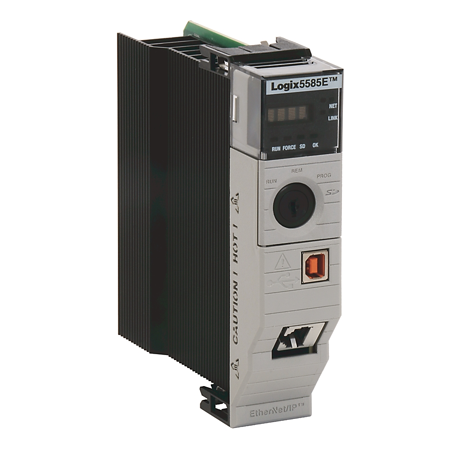
It is the highest-performance standard controller in the ControlLogix 5580 family. It executes user logic, manages I/O and motion control over EtherNet/IP, and serves as the central processing unit for large-scale industrial automation systems, including process control, complex motion, and high-speed discrete manufacturing.
Q2: Does the 1756-L85E have a built-in Ethernet port?
Yes. Unlike the older 5570 series (which required a separate EN2T/ENBT module for networking), the 5580 series features a built-in 1 Gb (Gigabit) Ethernet port on the front of the controller. This port supports EtherNet/IP communication for I/O, HMI, and controller-to-controller messaging.
Q3: Can the 1756-L85E be used in a redundant (ControlLogix Redundancy) system?
No. According to the official ControlLogix selection guide, controller redundancy is not supported on 5580 series controllers — it is listed as a future capability. For redundant applications, the 1756-L7x series (e.g., 1756-L71, L72, L73, L74, L75) must be used with the 1756-RM2 redundancy module.
Q4: What is the difference between the 1756-L85E and the 1756-L75?
The 1756-L85E (5580 series) is the newer generation with 40 MB memory (vs. 32 MB on the L75) and a built-in 1 Gb Ethernet port (the L75 has no embedded Ethernet). The L85E also supports 300 EtherNet/IP nodes (vs. 250 on the L75 with v30+ firmware). The L85E is the recommended replacement for the L75 in new designs.
Q5: What firmware and software are required for the 1756-L85E?
The controller requires Studio 5000 Logix Designer for programming. To achieve the full 300 EtherNet/IP node capacity, Logix Designer version 28 or later is required. For the 250-node limit (with L83E/L84E), version 30 or later is needed. The controller uses non-volatile memory for program retention and does not require a lithium battery — it uses an embedded energy storage module.