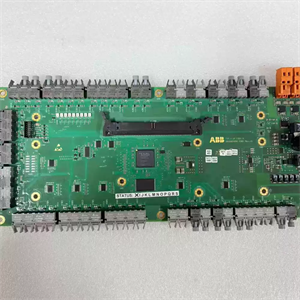
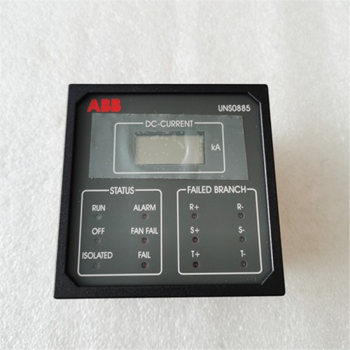
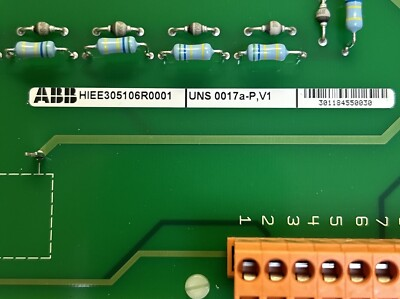
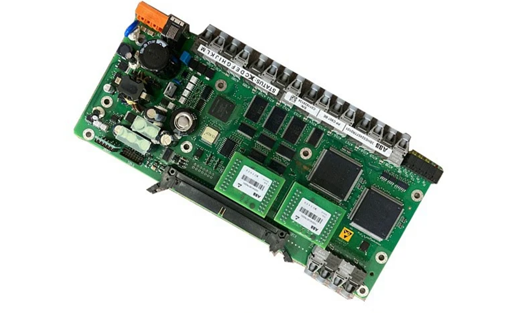
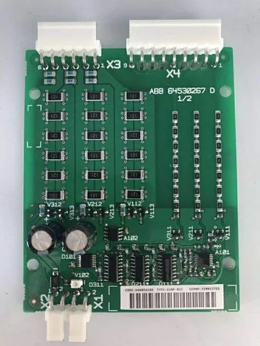
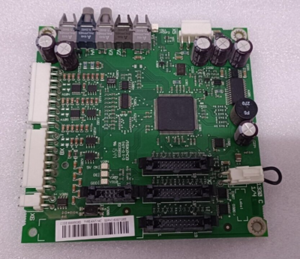
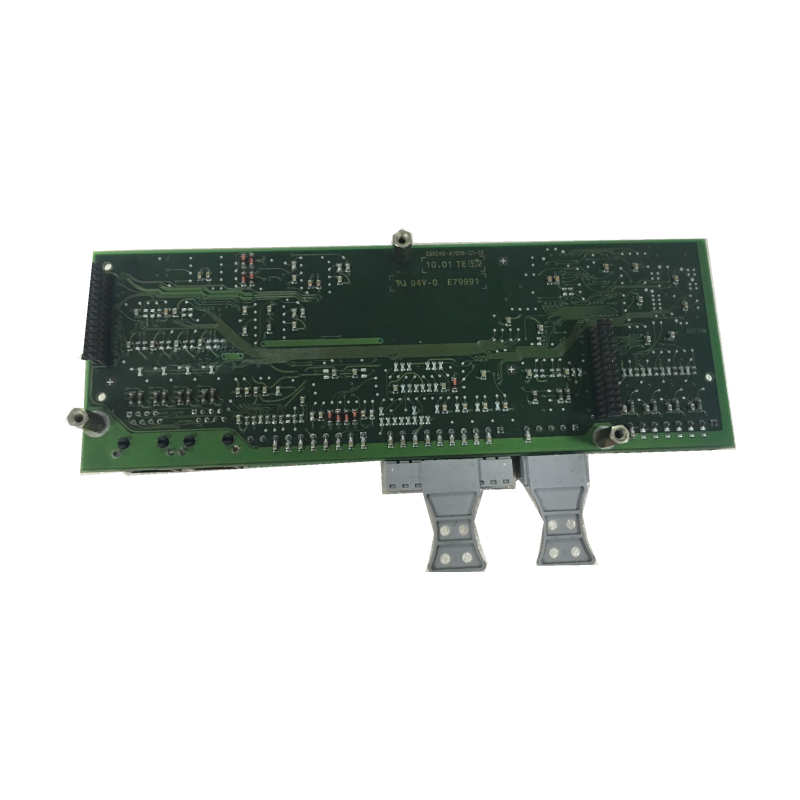
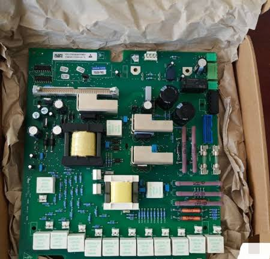
Products Description
Core Features & Advantages
-
Integrated PWM Generation and Hardware Protection: The module's standout feature is the tight integration of PWM pulse generation and hardware-level protection on a single DSP+FPGA architecture. This shortens the response path, enabling microsecond-level hardware shutdown for IGBT/IGCT short-circuit protection. In medium-voltage drives where short-circuit energy can reach several kiloamperes, this speed is critical—a delay of just a few hundred nanoseconds can result in catastrophic power semiconductor destruction.
-
High-Precision Motor Control with DTC: Equipped with a 32-bit floating-point DSP, the board executes ABB's proprietary Direct Torque Control (DTC) algorithm with a control loop refresh period of 50 µs. This provides fast torque response and accurate speed control (encoder mode accuracy ±0.1% of rated speed; torque control accuracy ±3%) without requiring a feedback device in most applications, ensuring high efficiency and smooth operation across the entire speed range.
-
Comprehensive Signal Acquisition and Flexible I/O: The board integrates extensive I/O capabilities, including 6 configurable analog inputs for DC bus voltage, motor current, and IGBT temperature monitoring; 16 isolated digital inputs for emergency stops and interlock signals; and 2 high-frequency encoder interfaces for closed-loop speed feedback. This eliminates the need for many external signal conditioning components, simplifying system architecture.
-
Fiber-Optic Isolation for High-Voltage Safety: The module outputs PWM pulses to the IGBT power units via fiber-optic channels, providing complete galvanic isolation between the low-voltage control electronics and the high-voltage power stage. The control-side to fiber-optic/power-side isolation is rated at ≥2.5 kV AC, effectively blocking transient voltages from the power cabinet from entering the sensitive control circuitry.
Typical Applications
The UF C921 A101 is widely used as a critical control component in ABB medium-voltage drive and excitation systems:
-
Medium-Voltage Drives: Core control board for ACS 6000 / ACS 2000 inverter units, controlling the PWM triggering of IGBT/IGCT power stacks in mining hoists, cement mill main drives, and ship propulsion systems.
-
Excitation Systems: Firing pulse amplifier and fiber-optic interface card in UNITROL 5000/6000 static excitation systems, transmitting trigger pulses to power cabinet pulse receiver boards and feeding back cabinet status alarms to the regulator.
-
DCS Integration: Interface board connecting Advant Master controllers to Masterbus 300 network devices, supporting up to 16 nodes for process control applications in chemical, oil & gas, and power generation industries.
Frequently Asked Questions (FAQ)
Q1: What is the primary function of the UF C921 A101?
A: It is an inverter control board that generates PWM trigger signals to drive IGBT/IGCT power modules, monitors DC bus voltage and current feedback for protection, and communicates with the upper-level control system via internal bus or fieldbus interfaces.
Q2: Which ABB drive systems is this board compatible with?
A: It is primarily used in ABB ACS 6000 / ACS 5000 medium-voltage drives (inverter unit control), ACS 2000 drives, and UNITROL 5000/6000 excitation systems. It also serves as an interface board in Advant Master DCS for Masterbus 300 communication.
Q3: Can this board be hot-swapped?
A: No. The module does not support hot-swapping. Main cabinet power and high-voltage DC links must be fully isolated and discharged before removing or inserting the card to prevent gate driver damage, controller reset, or hazardous flashovers.
Q4: What is the difference between UFC921 A101 and A102/B versions?
A: The A101 is the early version control board for ACS 6000. The A102 and B versions are successors with updated firmware and CPLD loading files. While the hardware interfaces are largely compatible, firmware version mismatches can cause communication errors with the ASUP (Active Supply Unit Processor). It is recommended to keep both UFC921 boards in the same cabinet at the same version level or update firmware per ABB service bulletins.
Q5: What does the fault "PULSE LOSS" indicate?
A: A "PULSE LOSS" fault in the excitation regulator typically indicates that the UFC921 A101 is not outputting trigger pulses. This could be caused by a fiber-optic cable break, a failed gate driver circuit on the board, or a firmware/communication mismatch with the control board (UNS2880B-P). The front panel PWR/ERR/LINK LEDs can help quickly determine whether the fiber link is broken or the board itself has failed.
Q6: What precautions should be taken before replacing this board?
A: Before replacement: (1) Power off and discharge the DC bus; (2) Back up parameters and photograph version information and jumper settings; (3) Ensure the replacement board has the same part number, hardware revision, and firmware version; (4) Wear an ESD wrist strap during handling; (5) After installation, verify all fiber-optic connectors are properly seated and secure front panel retaining screws.
Recommended Models & Related Products
The UF C921 A101 is part of ABB's UFC control board family. Below are related models for different drive and system configurations:
Choosing the Right Model
-
For ACS 6000 medium-voltage drives: The UF C921 A101 (3BHE024855R0101) is the correct inverter control board for the INU (Inverter Unit), managing PWM triggering and protection for IGBT/IGCT power stacks.
-
For system upgrades or replacements: Verify firmware version compatibility between the UFC921 board and the ASUP (Active Supply Unit Processor). If the cabinet already contains A102 or B versions, use the same version or consult ABB service documentation for firmware update procedures.
-
For excitation system applications: Pair with UNS2880B-P control board and RDCU pulse receiver boards for complete UNITROL firing chain integration.