Products Description
Allen-Bradley 1757-SRM ProcessLogix & ControlLogix System Redundancy Module
| Model Number |
1757-SRM |
| Place of Origin |
USA |
| Dimension/Weight |
0.5 kg |
| Condition |
new and original |
| Warranty |
1 year |
Shipping term
|
DHL Fedex TNT EMS UPS |
| Payment |
TT / Western Union |
| Delivery Time |
3-5 days |
Service
|
24 Hours Online Service |
Packing&Delivery
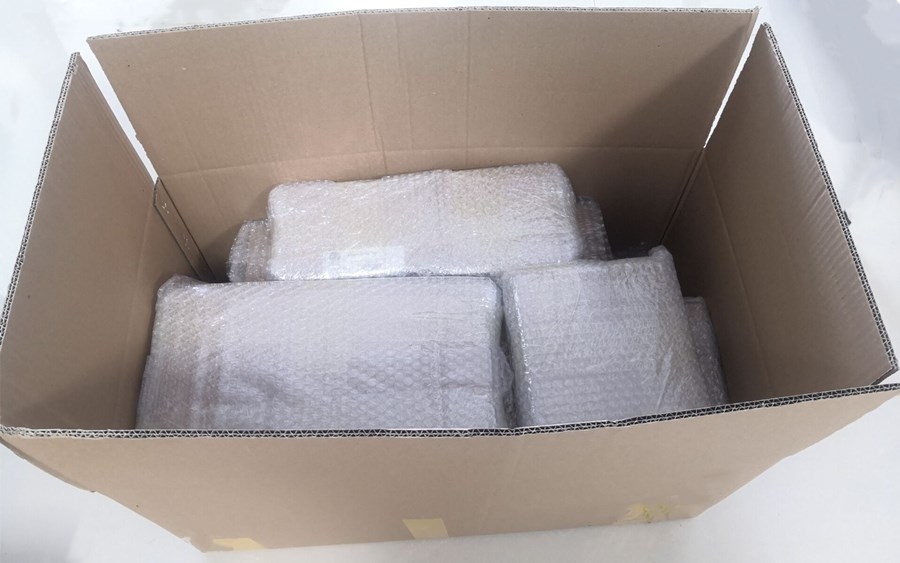
In order to save the freight and reduce your budget, we choose the packaging for environment-friendly. We use foam board with 3 cm thick to fill in all around the box inside to protect parts, then use carton to pack the parts, but if they are too heavy, we will customized the wooden box for them.Shipping term DHL Fedex TNT EMS UPS.
Core Advantages
Controller Redundancy for High Availability
The 1757-SRM enables a primary/secondary controller configuration where two identical ControlLogix chassis operate in parallel. The secondary chassis continuously synchronizes with the primary, ready to take over control in the event of a primary controller fault or failure .
Dedicated Fiber-Optic Synchronization Link
The module uses a 62.5/125 µm multi-mode fiber-optic cable with an SC connector to synchronize the primary and secondary chassis. This fiber link provides high-speed, noise-immune communication for synchronizing program logic, I/O data, internal variables, and communication buffers .
Seamless Switchover Within One Scan Cycle
When a fault condition triggers a switchover, the secondary controller assumes control within a single scan cycle. This "bumpless" transition ensures that field devices continue operating without interruption, minimizing production downtime in critical processes .
Hot-Swap Capability in Redundant Configuration
In a properly configured redundant system, a failed 1757-SRM module can be replaced online. After replacement, the system automatically re-synchronizes without requiring a full process shutdown, reducing maintenance costs and downtime .
Visual Status and Diagnostic Indicators
The module includes PRI (Primary), COM (Communication), and Health LEDs, along with text status codes displayed on the front panel. These indicators provide immediate visibility into the redundancy system state, module role, and fault conditions for rapid troubleshooting .
Proven Platform for Critical Industries
The 1757-SRM is deployed in power generation, oil and gas, petrochemical, and water treatment applications where continuous operation is essential. The redundant controller architecture protects against single points of failure in the control system .
Application
The Allen-Bradley 1757-SRM is deployed in critical control scenarios requiring high availability:
-
Power Generation: Maintains continuous control of boilers, turbines, and auxiliary systems where unexpected shutdowns are costly and potentially hazardous .
-
Oil and Gas Processing: Provides redundancy for process control in refineries, pipelines, and offshore platforms where safety and uptime are paramount .
-
Petrochemical Plants: Protects critical control loops in chemical processing where a controller failure could lead to unsafe conditions or production loss .
-
Water and Wastewater Treatment: Ensures uninterrupted operation of treatment processes in municipal and industrial facilities .
-
ProcessLogix Systems: Serves as the redundancy backbone for ProcessLogix DCS installations, synchronizing controllers across primary and secondary chassis .
FAQ
Q1: What is the primary function of the 1757-SRM?
It is a System Redundancy Module that enables controller redundancy in ControlLogix and ProcessLogix systems. Two SRM modules (one per chassis) synchronize the primary and secondary controllers over a fiber-optic link, allowing automatic switchover if the primary fails .
Q2: What is the difference between the 1757-SRM and the 1756-RM?
The 1756-RM is the enhanced redundancy module. Key differences: the 1757-SRM occupies 2 slots while the 1756-RM occupies 1 slot; the 1757-SRM supports standard modules (1756-CNBR, 1756-ENBT) while the 1756-RM requires enhanced modules (1756-CN2R, 1756-EN2T); and the 1757-SRM supports only one controller per chassis .
Q3: What fiber optic cable is required for the synchronization link?
The 1757-SRM requires 62.5/125 µm multi-mode fiber optic cable with SC connectors, operating at 1300 nm wavelength. Compatible cables include the 1757-SRC1 (1 m), 1757-SRC3 (3 m), 1757-SRC10 (10 m), 1757-SRC50 (50 m), and 1757-SRC100 (100 m) .
Q4: Can the 1757-SRM be hot-swapped?
In a redundant configuration, yes. The module can be replaced online, and the system will automatically re-synchronize after replacement. However, always follow proper procedures and verify system state before removing any module .
Q5: What firmware upgrade path is required for the 1757-SRM?
There are critical restrictions: Do not upgrade from version 2.xx directly to 4.3 or later—this will permanently damage the module. You must first upgrade to any 3.xx version (from version 13 bundles), then upgrade to 4.xx. Also, upgrading from revision 11 or 13 requires an indirect path through revision 15.60 first .
Q6: What happens if I flash both 1757-SRM modules simultaneously?
If the SRM modules in the redundant chassis pair are flashed simultaneously, the module may display an E700 OS ERR. To recover, power-cycle the module after the flash completes. To avoid this, flash each 1757-SRM module separately .
Q7: What is the known issue with the primary SRM when the secondary controller is removed?
Under rare conditions, when a secondary controller is removed or faults while synchronized, the primary 1757-SRM may display an E054 error. To recover, remove the primary 1757-SRM from the rack and re-insert it. This causes all modules in the secondary to disqualify, allowing re-qualification to proceed .
Q8: What should I check if synchronization fails?
Common causes include: the secondary SRM rejecting a command (send commands to the primary SRM instead); compatibility mismatches between primary and secondary chassis modules; and high connection counts near controller limits. Verify that both chassis have identical modules, slot positions, and firmware revisions .
Recommended Models